
World Builder's and Dungeon Builder's Guidebooks: Different Scales of Design
Editorial date: · TSR Archive
One package has world-design forms; the other advertises 78 dungeon geomorphs. Compare the two AD&D books by what you need to prepare next.
World Builder's Guidebook and Dungeon Builder's Guidebook are designed to complement one another, but they start at different scales. One helps shape a campaign world and supplies forms. The other concentrates on adventure sites, with 78 geomorphs among its advertised tools. Choose the scale of your next preparation task before choosing the book.

Campaign premise or a place the party can enter?
Richard Baker's 1996 World Builder's Guidebook, TSR 9532, begins with the campaign hook and works through increasingly specific places. Its description ranges over continents, societies and ecologies as well as religion and history. The point is a usable framework for a campaign, not simply a random floor plan.
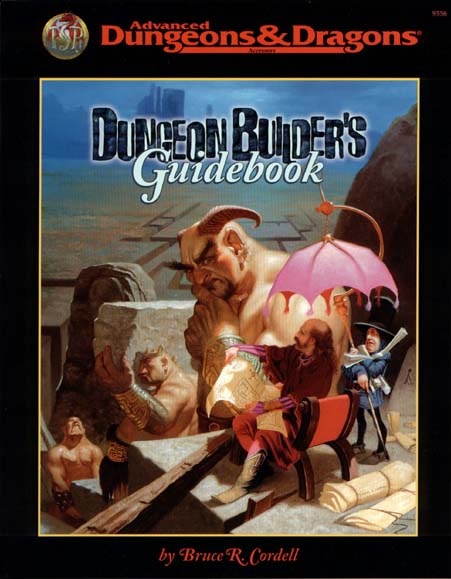
Bruce R. Cordell's 1998 Dungeon Builder's Guidebook, TSR 9556, narrows the job to sites. It advertises six dungeon types with property and encounter tables. The publisher explicitly describes it as a complement to the World Builder volume. That statement establishes a relationship between the tools, not a requirement to finish an entire world before designing a dungeon.
Forms and geomorphs are different kinds of loose work
| Product | Recorded format | Advertised work aids |
|---|---|---|
| World Builder's Guidebook, 9532 | 96-page book and 64-page tablet | 32 copyable forms, mapping paper and hex sheets. |
| Dungeon Builder's Guidebook, 9556 | 64-page book | 78 geomorphs, a Trap Architect and an Autodungeon Engine. |
The world book's 32 forms and the format field's 64-page tablet describe different units. They should not be collapsed into a claim that the tablet contains exactly 32 pages or that half of it is missing. Inspect the actual pad and its organization if completeness matters.
The dungeon description offers geomorphs for copying, tracing or drawing freehand. Its Autodungeon Engine joins randomly selected pieces. The Trap Architect addresses traps. Those are distinct tasks within site preparation. Finding a book with maps does not establish that a separate pad from the other product is included.
Stop world design where the next session needs detail
If the party needs a reason to travel and a relationship between two communities, the world book's campaign and society prompts address that job. If next session begins at an unexplored entrance, start with the dungeon book's site tools. A referee can use either approach without making ownership of both a prerequisite.
For an existing setting, write down the established facts first. The Greyhawk folio and box comparison illustrates how published maps and setting packages already carry commitments. Use a generator to fill an unanswered area instead of silently replacing a known border or settlement.
With randomly joined dungeon pieces, inspect the result before play. Decide what the connections mean and whether the site serves the adventure's purpose. Keep your choices with the map so you can distinguish a generated starting arrangement from the finished location. For digital or print-on-demand copies, verify what happened to the forms and other work aids. The original physical-format field does not certify a later edition's construction.
Sources and scope
Product identification and reproduced publisher descriptions: dd1/wbg.htm; dd1/dbg.htm. Cover images are preserved local archive files, linked to their source records above. No assertion that photocopyable forms survive in every digital edition or that both books are required. Preparation methods in this article are editorial recommendations, not a report of a new playtest.