Greyhawk's Folio and Box: What Changed Around the Maps?
Editorial date: · TSR Archive
Two poster maps accompany both early packages. Compare the books, identify the format and record which map and campaign references your table will use.
A familiar map can make two Greyhawk products look more alike than their contents are. The early folio and the later boxed set both include two fold-out maps, yet the books around those maps differ substantially. Identify the package before deciding that a copy duplicates what you already own.
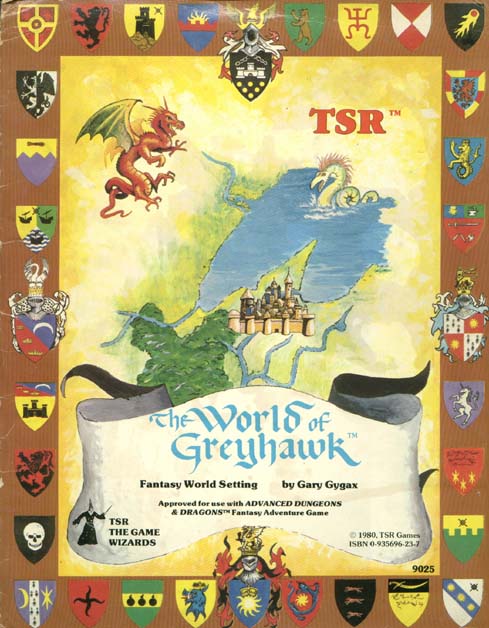
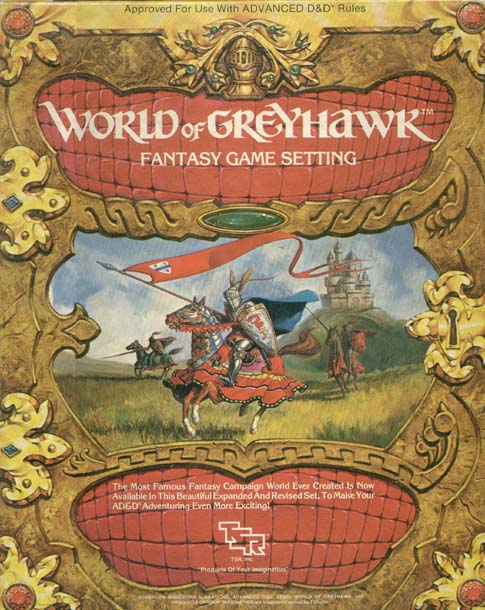
The 1980 archive record names Gary Gygax and TSR 9025. The 1983 record identifies TSR 1015. These product numbers give a more dependable starting point than the word Greyhawk on a seller's listing.
A folio is not an empty box
| Product | Books and enclosure | Maps |
|---|---|---|
| The World of Greyhawk, 1980, 9025 | A 32-page book with an oversized tri-fold cover. | Two fold-out maps. |
| World of Greyhawk Fantasy Game Setting, 1983, 1015 | A boxed package with a 48-page book and an 80-page book. | Two fold-out maps. |
The physical distinction matters when checking completeness. A surviving folio cover and booklet should not be judged against the boxed set's inventory. Conversely, the presence of the maps does not show that both books from the box are present.
Ask for an opened view of the actual package. Record the book titles, identifying pages and map sheets shown. If an item is not visible, mark it unverified rather than either present or missing. The resulting inventory should describe that copy, not an ideal set assembled from photographs of several different listings.
The map has its own publication history
Cartographer Anna B. Meyer's overview of published Flanaess maps identifies Darlene's two-part map with the 1980 folio and describes its reuse for the 1983 box. That continuity helps explain why the packages can appear so familiar at first glance.
A continuing map tradition does not make every accompanying reference interchangeable. Read the map and book as related artifacts. One establishes places and spatial relationships; the other supplies the information you will use to interpret those places in a particular campaign.
This is also why a map offered separately should retain its own provenance note. Record which package it came from if that is known. Do not identify a specific printing from an indistinct photograph merely because the broad geography looks right. This article has not collated all physical printings of those sheets.
Choose a campaign reference before adding lore
For play, write down which book provides the starting description of your chosen area. You do not need to resolve the whole publication history of Greyhawk before running a journey. You do need to know which reference governs a disagreement at your table. Keep a separate note for later material you decide to import. If a later source changes a political situation or offers a different interpretation, compare it with the campaign already in progress. Accepting an addition is a deliberate choice, not a correction that the players must pretend was always true.
Apply the same discipline to scale. Use the world map for the journey it can represent, then choose or prepare a local map for the immediate adventure. A large region should not acquire detailed roads, settlements or travel obstacles merely because the referee needs them during an improvised scene. Mark your additions and retain them for the next visit.
What would another copy add?
A reader interested in the early presentation may want the folio as an artifact in its own right. A referee may instead want the books and reference material in the later box. These are different reasons to choose a product; neither can be settled by counting familiar place names on the maps.
Compare the actual material you have with the inventory of the version you are considering. If only a map is absent, identify that gap precisely. If your copy contains only a book, describe it as that book rather than a complete setting package. The same principle applies to the different Forgotten Realms boxes, although their product-number problem is different.
Keep the inventory sheet with the maps and books. It should state what was inspected, what remains uncertain and which reference the campaign uses. A later reader can then distinguish a physical omission from a change you intentionally made to Greyhawk.
Sources and scope
The archive supplies the two product numbers and component inventories. Meyer's attributed cartographic overview supplies the map-continuity observation. No exhaustive map comparison, market valuation or complete chronology of later Greyhawk revisions is claimed.