
Wilderness Survival Guide: Kim Mohan's Research and the Rules You Choose
Editorial date: · TSR Archive
Mohan describes his research in the 1986 preface. Use the contents and introduction to separate player-facing wilderness procedures from DM-only material.
Kim Mohan described writing Wilderness Survival Guide as a research journey. In his preface dated September 5, 1986, he recalls borrowing research material from Frank Mentzer, following a book suggestion from Zeb Cook and visiting public libraries. The resulting AD&D volume turns outdoor conditions into things a group can prepare for and adjudicate.
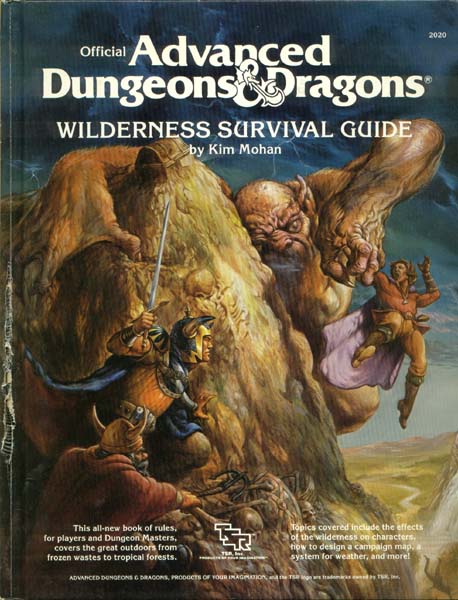
The preface records research, not a field expedition
The publisher-hosted sample contains that preface, the contents and the introduction. Mohan uses a journey as a metaphor for the writing process. It should not be transformed into a story that he personally tested every hazard outdoors. The archive identifies a 128-page hardcover, TSR 2020, from 1986.
That distinction is useful when reading an old game supplement: an author can explain how he gathered material without certifying the rules as real-world instruction. Here the practical question is which outdoor events your campaign will track. A river crossing can be a short transition in one game and the central problem of an expedition in another. Decide its role before adding procedures.
Find the relevant systems before adding them
The sample contents cover nonweapon proficiencies, weather, movement and provisions, with separate material intended for the DM. Its introduction gives the referee room to modify the material for the campaign. Those features support a selective reading plan. They do not require a group to adopt the whole book at once.
| Campaign question | Reading target | Decision to record |
|---|---|---|
| Who can attempt the task? | Proficiencies and the introduction's terminology | Use a consistent procedure with the party's existing character records. |
| What makes the route difficult? | Environment and movement material | Identify which conditions change decisions along this particular route. |
| What must the party carry? | Food, water and camping sections | Tell the players what supplies the campaign expects them to track. |
| What does the referee determine? | DM material and weather appendix | Keep the method and any undiscovered conditions in referee notes. |
The table is a preparation aid written for this article. It is not an additional TSR rule. For example, choosing to track provisions creates a reason to establish the party's supplies before departure. It does not by itself select a new damage schedule or overland movement rate.
Make the information boundary clear to players
The introduction distinguishes material for general use from the smaller DM portion. It also treats knowledge of a procedure differently from certainty about a particular outcome. A player who knows that weather matters still needs information about conditions on the route. Tell the group which procedures it can consult, and reveal conditions through the characters' observations rather than displaying all your referee notes.
For a first expedition with this supplement, choose a limited route and mark the moments when an adopted procedure will matter. Note the party's departure state, record a changed condition when it occurs and keep a reference to the rule used. Expand only when another part of the book answers a question the campaign actually raises.
The Dungeoneer's Survival Guide article discusses underground space and vertical mapping. The two books have related titles, but the outdoor hardcover serves a different preparation job. None of the game material here is offered as practical wilderness safety instruction.
Sources and scope
Product identification and reproduced publisher descriptions: dd1/wsg.htm. Cover images are preserved local archive files, linked to their source records above. Not real-world survival advice, a full rules reproduction or evidence every optional system must be used. Preparation methods in this article are editorial recommendations, not a report of a new playtest.