
Dungeoneer's Survival Guide: The Underdark Has Height
Editorial date: · TSR Archive
The 1986 introductions connect nonweapon proficiencies, underground movement and campaign design. Use the contents to choose rules for a vertical expedition.
An underground map can show every room while concealing the most important fact about a journey: one passage may be far above another. Dungeoneer's Survival Guide treats the underground environment as a problem of movement and world design as well as encounters. Its original introductions explain why those subjects belong together.
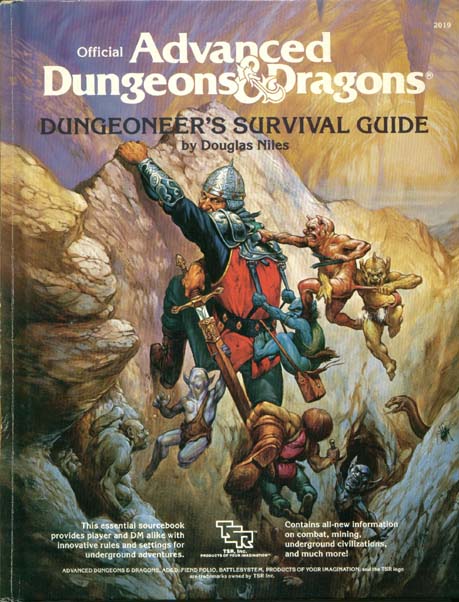
The archive identifies Douglas Niles's 1986 book as TSR 2019, a 128-page hardcover. The accessible original preview contains the author and editor's introductions, credits and contents. Those pages provide a useful way into the book without requiring you to adopt every additional procedure at once.
Two introductions, a shared problem
In the original preview, Niles's introduction is dated April 22, 1986; Mike Breault's follows with a May 12 date. Niles connects underground movement with an expansion of the nonweapon proficiencies introduced in Oriental Adventures. He also describes Deepearth as a sample underground setting.
The credits name Dave Sutherland for cartography and diagrams. Breault's introduction explicitly connects three-dimensional mapping with campaign creation and other referee techniques. Read together, these are a statement of the project's intended scope: the book supplies procedures and ways to organize the environment in which those procedures matter.
That scope does not make every rule mandatory. Before using a new procedure, identify the existing rule or ruling it will replace at your table. Keeping both in use without an agreed boundary can make a character's chance of success depend on which book the referee happens to open.
Draw the route as a sequence of obstacles
The following worksheet is an editorial preparation aid for a hypothetical underground route. It does not reproduce a keyed location from Deepearth or calculate a result from rules outside the preview.
| Route feature | What the map must explain | Reference to prepare |
|---|---|---|
| A drop between passages | Which passage is higher, and where the party can stand. | The chosen movement and rope procedures. |
| A water crossing | Where entry and exit are possible and what the characters can observe. | The relevant swimming and equipment treatment. |
| A narrow connection | Who can pass, in what order and with what carried equipment. | The procedure used for confined movement. |
| A way back | Whether the route remains usable after the party passes. | A record of altered equipment, access or terrain. |
A plan view can remain the main map. Add a side sketch where height changes a decision, and label its connection to the plan. A beautiful diagram that cannot be matched to the encounter text is less useful during play than a plain, clearly referenced section.
Decide how skills enter the campaign
Separate the adoption of a proficiency system from the decision to make an individual ability check. The former affects character preparation and expectations across sessions. The latter may be a ruling about a particular action. Explain which approach the campaign uses before an obstacle makes the distinction consequential. When reading the book, mark the procedure's trigger, the information the player needs and the result the referee must interpret. Consult the full rules for the actual mechanics. This article does not supply a substitute success table or reconstruct climbing probabilities from the contents page.
Also check for overlap with the rules your campaign already uses. A character option from another supplement should not silently gain or lose its role because a new environmental rule has been added. The Player's Option dependency guide concerns later books, but the preparation question is relevant here too: what changes when this subsystem enters play?
Use the setting example at the scale you need
Niles presents Deepearth as a setting to expand or as a guide to constructing another underground campaign. You can therefore begin with a limited connected area. Record how the party enters it, where it can acquire information and which routes lead beyond the prepared material.
Preserve that route record after the session. An obstacle passed on the outward journey may matter differently when the party returns carrying treasure, helping an injured companion or lacking equipment left behind. These are situations for your campaign to resolve, not extra published events attributed to the book.
For the next expedition, open the map at the route actually chosen and place the relevant rule references beside it. Add the vertical sketch only where it changes that route. The guide's range becomes useful when the referee can retrieve the part the players need now.
Sources and scope
Identity and format come from the archive. The linked preview's introductions and credits support the proficiency lineage, sample setting and mapping discussion. No claim is made that the book invented underground play or supplied the first use of every associated term. The route worksheet is editorial guidance, not a playtest report.