
I1 Dwellers of the Forbidden City: A Tournament Inside a Larger Sandbox
Editorial date: · TSR Archive
The 1981 module includes eight maps and material for repeated visits. Separate the tournament brief from the additional work of preparing a mini-campaign.
A tournament adventure and a place worth revisiting do not ask the same things of a referee. Dwellers of the Forbidden City offers both. Its original description says that parts were used in a major East Coast convention tournament in 1980, then explains that the published module adds material for repeated adventures in a mini-campaign.
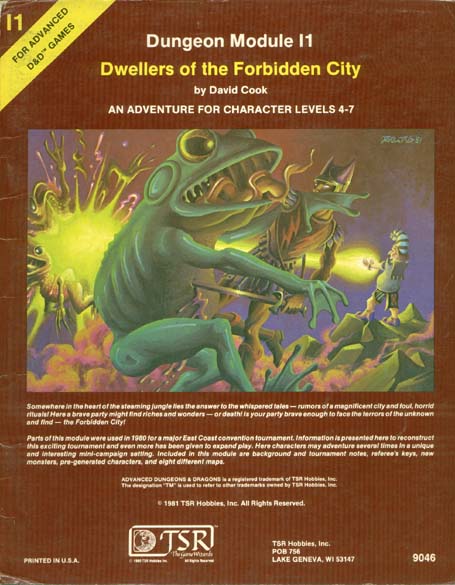
The archive identifies I1 as David Cook's 1981 adventure, TSR 9046. The tournament connection is documented in the original product description. It does not establish that every part of the retail adventure was present at the convention.
Choose the play format first
For a convention-style session, agree on a starting situation, an objective and a session limit. Use the module's tournament notes where they supply the needed information. Do not invent a scoring system and attribute it to Cook simply because the adventure has a tournament ancestor.
A continuing campaign needs another kind of preparation. The party may retreat, pursue a different lead or return after its first expedition has changed something. The location must remain usable after the initial objective is resolved. Decide which surrounding details can wait until the players show an interest in them.
| Question | Bounded session | Continuing mini-campaign |
|---|---|---|
| Where do we begin? | Use a defined brief and the appropriate tournament material. | Prepare an entry situation and the information needed to choose a direction. |
| What must be ready? | The route, references and encounters relevant to the agreed session. | Reachable locations plus consequences that may survive a return visit. |
| What happens afterward? | Record the result against the session's own conditions. | Update relationships, discoveries and unfinished objectives. |
The table is an editorial preparation framework. It separates two uses that the publisher advertises. It does not reconstruct a missing tournament packet.
Eight maps do different work
The original description lists eight maps, alongside background, referee keys, new monsters and pregenerated characters. Before preparing a particular expedition, connect each map you will use to the text that explains it. The number of maps does not tell you which are suitable to show to players.
Make a small map register with the printed map title or identifier, the matching text reference and a note about who can see it. Record any annotation you add. Keeping a referee's interpretation apart from the supplied map prevents an improvised boundary or route from becoming an accidental fact about the published city.
For a digital copy, check readability at the scale you intend to display. On paper, make sure an opened cover or loose sheet can remain accessible while the encounter text is in use. This is a handling check, not a reason to redraw the entire city before a first session.
What survives the first expedition?
Repeated play needs a record of changes. Keep the starting condition of a location separate from its condition after the party leaves. If the group made an agreement, disturbed a site or abandoned a plan, write down the consequence you have actually established. Preserve uncertainty too. A player theory is not a confirmed discovery, and an unanswered question need not become a new plot immediately. Note what evidence remains available when the group returns. The next expedition can then begin with a choice informed by earlier play.
There is a useful contrast with X1's wilderness instruction. X1 frames an island as a model for wilderness adventures. I1's product description explicitly preserves a tournament use while inviting a larger campaign. Neither requires you to write every possible journey before the party has chosen one.
Keep the historical claim narrow
The surviving catalog description names an East Coast convention and a year, but it does not name the convention in the text reproduced here. That is the limit of this article's claim. A more specific identification needs another source.
For your own campaign copy, label the material you intend to use for a short session and the material reserved for later visits. That simple distinction makes the expanded retail adventure easier to handle without treating its whole city as a single timed encounter.
Sources and scope
Identity, the 1980 tournament connection, eight-map inventory and mini-campaign offer come from the original publisher description reproduced in the linked archive entry. Preparation tables and record suggestions are editorial additions. No convention identity, scoring reconstruction or playtest result is asserted.