
Desert of Desolation: Three Modules, a Later Collection and a Standalone Pharaoh
Editorial date: · TSR Archive
Desert of Desolation: the 1987 I3-5 collection has a separate 16-page map book. Compare I3, I4 and I5, including Pharaoh's standalone permission.
Desert of Desolation can mean the three-module series or the later I3-5 collection. The distinction affects both the book you read and the maps you need. It does not mean that you must own all three original modules before running Pharaoh.
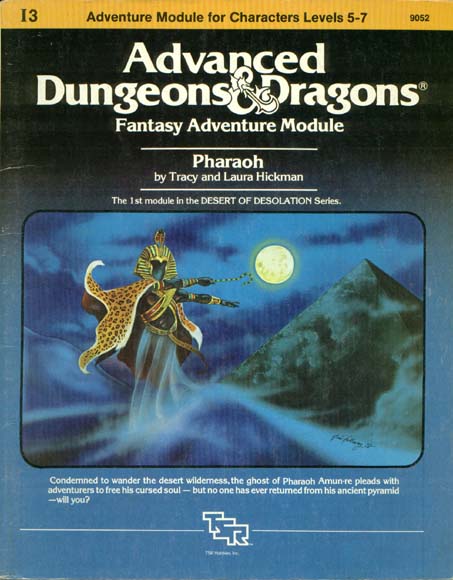

Pharaoh explicitly permits a standalone expedition
The official six-page Pharaoh sample identifies Tracy and Laura Hickman as authors, gives levels 5-7 and states that the module works independently or as the opening part of the series. That is a direct answer to a preparation question often obscured by the trilogy label.
The original sequence is I3 Pharaoh, I4 Oasis of the White Palm and I5 Lost Tomb of Martek. Their archive records date them 1982, 1983 and 1983 respectively. The I4 record credits Philip Meyers with Tracy Hickman; I5 credits Tracy Raye Hickman. Keep those identities with the separate modules instead of assigning the whole series a single date and author line.
The premises develop different parts of a desert journey. Pharaoh brings the party to Amun-re's tomb. The later descriptions introduce another oasis adventure and Martek's legacy, including the glass Skysea and a cloudskate. That is enough context to recognize the series without revealing encounter solutions.
The 1987 collection is its own physical package
| Product | Archive format | Reference consequence |
|---|---|---|
| I3, TSR 9052 | 32-page book | Use its own map and encounter references for standalone Pharaoh. |
| I4, TSR 9053; I5, TSR 9054 | Each a 32-page book | The next two separately published parts. |
| I3-5, TSR 9199; 1987 | 128-page book, 16-page map book and fold-out map sheet/player handouts | Inspect the separate aids as well as the main volume. |
The collection's description places the journey in Raurin, the Desert of Dust, and names Bralizar and the Dustwall in its framing. It also carries a broader credited author list than any single original module. These are reasons to follow the edition actually in use. A larger page total does not prove which rooms were expanded, removed or copied unchanged.
Choose the scope before combining references
For a short campaign commitment, begin with I3 and its explicit standalone option. For a linked desert campaign, read the transition material in the particular originals or collection you have chosen. If borrowing a map from another package, match the names and keys first. Preserve the difference between a player handout and a referee plan.
A compact preparation sheet can record the current location, its edition-specific page and the information the party has actually received. Leave future revelations on the referee side. The A1 and A1-4 comparison covers a different collection's revision claims; it does not establish what changed in I3-5. This article identifies the formats and the standalone permission, without inventing a complete revision list.
Sources and scope
Product fields, inventory and reproduced publisher descriptions: dd1/i3.htm, dd1/i4.htm, dd1/i5.htm, dd1/i3-5.htm. The cover images are preserved local archive files. No room-by-room revision list or assumption that matching titles mean identical maps. Preparation suggestions are editorial. No new playtest or unseen-copy authentication is claimed.