Dead Gods and The Great Modron March: Connected Stories Without a Required Purchase
Editorial date: · TSR Archive
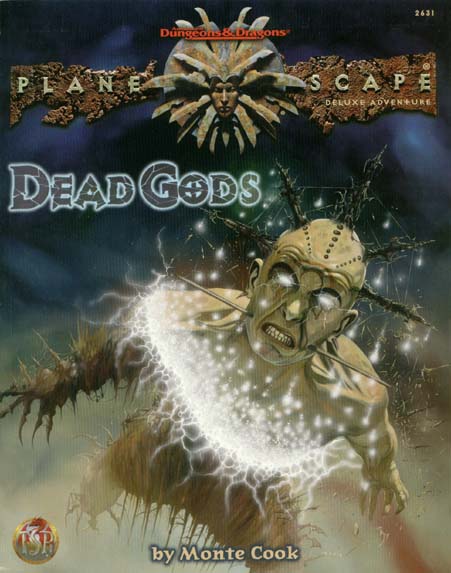
Dead Gods (1997) allows its two scenarios to stand alone or link. The earlier 11-adventure Great Modron March supplies optional story context.
Dead Gods builds on story material from The Great Modron March, but its publisher description explicitly says that the earlier book is not required. The two products also contain different internal structures: one offers a pair of scenarios, the other an anthology of eleven adventures.

A story connection is not a mandatory reading list
Both books are dated 1997 in the archive. Dead Gods, TSR 2631, is credited to Monte Cook. The Great Modron March, TSR 2628, is credited to Cook and Colin McComb. Their reproduced descriptions establish the connection and the permission to use the later adventure independently.
Start with Dead Gods if that is the campaign you want to prepare. If you already own the anthology, consider whether its earlier events would make a useful shared history for this group. The existence of a connection does not oblige you to run all eleven adventures before opening the other book. Nor does optional ownership mean that a referee never needs to explain a piece of story context. That explanation should come from the adventure being run.
Two different ways to assemble a campaign
| Book | What the publisher describes | Campaign choice |
|---|---|---|
| The Great Modron March | 128-page book; eleven adventures for levels 1-10 | Use individual adventures or link them as a longer campaign. |
| Dead Gods | 176-page book and fold-out map; two scenarios | Run the scenarios separately or link them together. |
The anthology follows an unexpectedly early modron procession from Mechanus around the Outer Planes. Its description asks why creatures associated with lawful regularity have departed from their schedule. The cover's striking statement that the next march was not due for 189 years is part of that premise, not a campaign calendar you must impose on every setting.
Dead Gods combines a larger planar mystery with another scenario involving a church and faction tensions in Sigil. Its brief also calls out a new fiend entry, player illustrations and a referee map sheet. The title alone does not tell you that there are two scenarios inside.
Track the choices that linking actually creates
Decide whether you are linking the two Dead Gods scenarios, selected Modron March adventures or material across both books. Those are separate decisions. Write each chosen transition into a short continuity record: what happened, who witnessed it and what the characters can reasonably know. Preserve undiscovered motives for later play.
Match player illustrations to their instructions, and keep the referee map separate from the material you display. If an adventure is introduced into an existing campaign at a different stage, check the party's abilities against that adventure's own guidance rather than assuming that an anthology's overall level range applies to every chapter.
The Planescape boxed-set and print-on-demand guide examines a different physical-format question. Here the archive identifies two adventure books. Their relation does not make either one a replacement for the campaign setting or the chosen AD&D rules. No major mystery solution or modern conversion is supplied here.
Sources and scope
Product fields, inventory and reproduced publisher descriptions: ps/ps-dead.htm, ps/ps-modron.htm. The cover images are preserved local archive files. No major villain reveal, full conversion or promise that any linked sequence needs no adjustment. Preparation suggestions are editorial. No new playtest or unseen-copy authentication is claimed.