
Descent into the Depths: D1, D2 and the Combined D1-2
Editorial date: · TSR Archive
The combined volume covers two earlier modules. Match each referee map to its player version and keep D3 separate from the D1-2 inventory.
The code D1-2 means that two earlier adventures have been gathered into one publication. It does not mean that the whole underground sequence is inside. The 1981 Descent into the Depths of the Earth record explicitly identifies its material as formerly published in D1 and D2, while naming D3 and Q1 as further parts of an extended adventure.


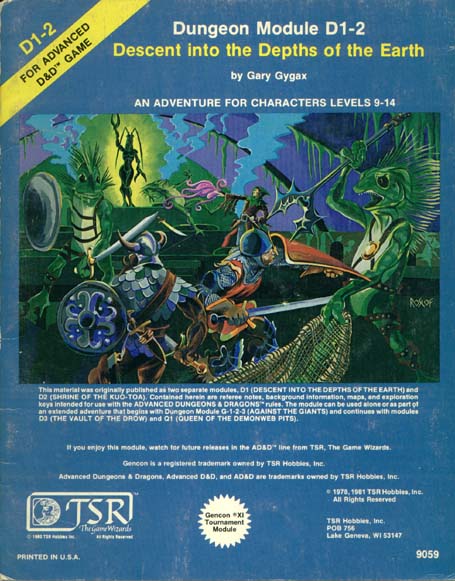
Keep the titles and numbers together
| Record | Number and date | Cataloged extent |
|---|---|---|
| D1: Descent Into the Depths of the Earth | 9019. 1978. | 16-page book with tri-fold cover. |
| D2: Shrine of the Kuo-Toa | 9020. 1978. | 20-page book. |
| D1-2: Descent into the Depths of the Earth | 9059. 1981. | 28-page book. |
Gary Gygax is credited on all three records. The repeated Descent title makes a title-only reference ambiguous: it can refer to D1 alone or to the combined volume. Add the code and stock number to a reading list or purchase inquiry. The recorded page extents identify the catalog descriptions. They do not establish which encounters were expanded, compressed or removed in a new layout. Vault of the Drow, D3, has its own record and product number, 9021. Do not count its maps as missing D1-2 components merely because a campaign synopsis places the adventures next to each other.
Two map audiences share the journey
The original D1 and D2 descriptions both advertise a large referee map with a matching partial map for players. That word partial matters. A player map is an information state, not simply a more convenient copy of everything the referee knows.
Start a map register with the source publication and intended audience. When a route is discovered during play, record how the characters learned it. If you prepare a digital handout, compare it against the player version before sharing it. Hiding room numbers on a referee map does not necessarily remove every undiscovered connection or destination.
Keep local encounter maps separate from the larger route map. The publisher descriptions distinguish cavern or temple areas from the broader exploration material. A referee needs to move between scales quickly, while the players need only the geographical information their current decisions can use. This preparation follows the described map roles. It does not introduce a new official exploration procedure.
A campaign sequence is not a compulsory reading order
The early descriptions allow the adventures to be played alone as well as within a linked sequence. D1-2 likewise offers standalone use or continuation from Against the Giants toward D3 and Q1. Those options put a task on the referee: choose the context the party actually enters with.
For an ongoing campaign, write a short arrival record containing the party's purpose and current geographical knowledge. For a standalone game, establish those facts directly in the opening briefing. Do not ask players to absorb the history of every earlier module merely to understand their immediate expedition.
The distinction between campaign geography and session information also appears in the Dungeoneer's Survival Guide discussion. That later rulebook supplies another approach to underground preparation. It is not evidence that its procedures were printed in the 1978 modules.
Sources and scope
The linked catalog records reproduce the original descriptions of sequence and map audiences. This article identifies publication boundaries and proposes a map register. It does not claim a textual collation of the separate and combined editions.