
U1 Saltmarsh: Beginning an Adventure Without Buying the Whole Series
Editorial date: · TSR Archive
The original brief specifies five to ten low-level characters. Distinguish the first adventure, its sequels and a modern virtual tabletop adaptation.
The original Sinister Secret of Saltmarsh offers a beginning-level AD&D adventure and identifies itself as the opening of a series. Those statements do not mean that a referee must acquire the whole series before preparing the first session. Start by identifying U1 itself, then distinguish what belongs to that adventure from what you want a longer coastal campaign to do.
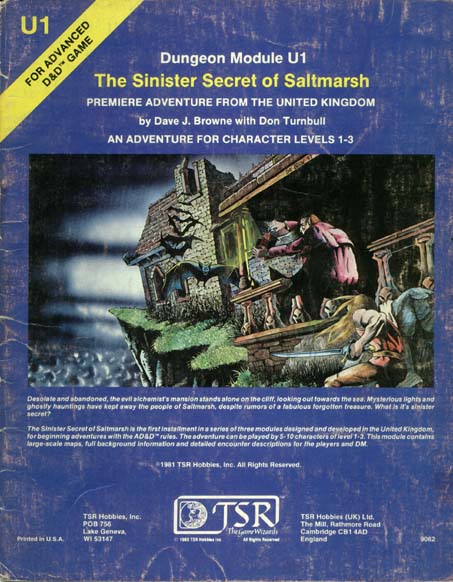
The archive records TSR 9062, written by Dave J. Browne with Don Turnbull, as a 1981 publication. Its advertised situation is an abandoned alchemist's mansion overlooking the sea. This article keeps the solution to its mystery out of the preparation discussion.
Read the size of the original party
The original description, also preserved on the licensed Fantasy Grounds page, specifies five to ten characters of levels 1 to 3. That is a more useful preparation fact than the loose label beginner adventure. A small modern group can differ substantially from the party the description addresses.
Count the characters who will actually enter the house, including any accompanying characters your campaign permits. Record their available resources and the ways they can retreat or seek help. Then read the opening encounters with that party in mind. A level range alone does not guarantee that an encounter suits every group inside it. Nor does beginning level necessarily mean a tutorial in every rule. The product promises background, encounter descriptions and maps. A new referee should still have the chosen AD&D rules available and know how that table handles searching, surprise and movement. Put those references beside the adventure rather than discovering their absence during the first uncertain action.
One installment and its neighbors
| Module | Place in your preparation |
|---|---|
| U1: The Sinister Secret of Saltmarsh | The starting text for the mansion mystery and the adventure that follows from it. |
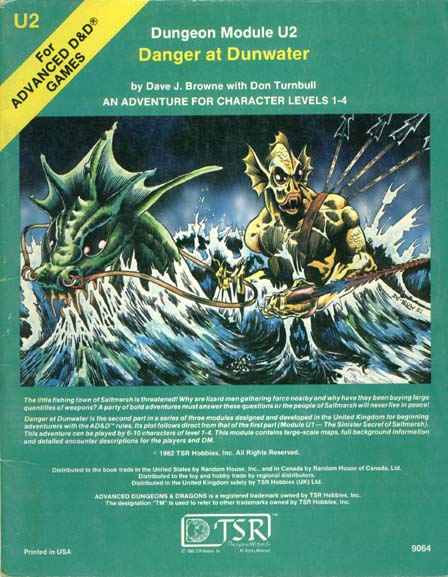
| U2: Danger at Dunwater | A sequel to examine when choosing how to continue beyond U1. |
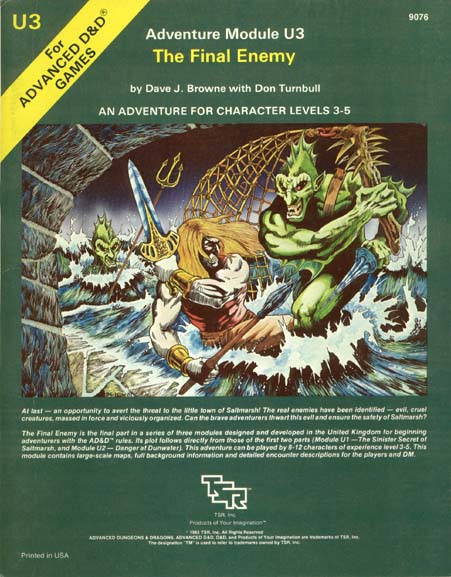
| U3: The Final Enemy | The later installment to consult when preparing the wider sequence. |
The historical detail worth retaining is the series' United Kingdom origin: U1's own description explicitly identifies the three modules as designed and developed there. That tells us how TSR presented this line. It does not prove a single design philosophy shared by every British adventure, and it should not become a claim that all their encounters must be approached in the same way.
Keep a short continuity note as U1 is played. Record what the party learned, whom it dealt with and what remains unresolved. When reading a sequel, compare its opening assumptions with that record. A continuation is easier to prepare when it follows the table's actual history.
Prepare evidence before explanations
The mansion's reputation and the characters' observations are different kinds of information. Make separate notes for what local people believe, what the party can directly observe and what only the referee knows. This is a preparation method, not an additional set of clues inserted into the module.
For each scene you expect to use, write down how an observation could become available. Can the party see it from outside? Does finding it require a particular action? Is it part of a conversation? Refer to the printed encounter when deciding. That keeps a dramatic explanation from arriving before the players have done anything that could reveal it.
The approach is narrower than building Restenford as a recurring campaign base. Here the immediate task is to keep a particular mystery intelligible. Background can remain brief until a player has a reason to ask about it.
A virtual tabletop package is another layer
Fantasy Grounds dates its adaptation to 2021 and states software requirements. Those details concern the digital product. They should not be used to identify the publication date or physical components of an original U1 booklet.
Before a session, open the map and the encounter material in the format you intend to use. Check what players can see and whether your own notes can be kept apart from displayed text. On paper, do the same check with the cover maps. A concealed reference is useful only if the referee can find it at the moment a player investigates.
Sources and scope
Product identity and the original brief come from the archive and licensed publisher description. The sequel links establish the archive's sequence, not a complete audit of all later campaign dependencies. Party review and evidence notes are editorial preparation suggestions.