
Shady Dragon Inn: One Cast, Two Ways to Find an NPC
Editorial date: · TSR Archive
Shady Dragon Inn lists characters individually and again in parties. Explore Carl Smith’s 1983 D&D accessory, its toy characters and its tavern role.
The Shady Dragon Inn lets a referee find a character by class or find a group already assembled. Those are two ways into the same cast. Carl Smith's 1983 accessory also connects D&D table statistics with characters represented in the contemporary D&D and AD&D toy line.
Individual and party listings serve different jobs
The archived publisher description advertises more than one hundred pregenerated characters. Each is listed individually by class and again as a member of an adventuring party. Short biographies, physical descriptions and item lists accompany the characters. Finding someone in the second arrangement therefore does not establish an additional distinct NPC.
| Need at the table | Useful arrangement | Check before use |
|---|---|---|
| Fill a particular character role | Individual listing by class | The character's statistics, possessions and description. |
| Introduce an existing adventuring company | Party listing | Which members belong together and how that group fits the scene. |
| Reconnect with a known character | Either route, using the same identity | Continuity with the party's earlier meeting. |
For a recurring NPC, keep one campaign note even if the book offers multiple lookup routes. Record changes to possessions or relationships there. That prevents the individual version and the party version from drifting into accidental duplicates during preparation. This is an editorial record-keeping suggestion, not an extra AC1 rule.
Toy branding and game statistics are separate identifiers
The reproduced brief expressly supplies D&D statistics for characters represented by D&D and AD&D toys. The photographed record at Tome of Treasures connects the accessory to the LJN line and names Strongheart, Warduke and Elkhorn. The illustration of a familiar toy character can help identify the character, but the toy's branding does not change the printed rules system.
If bringing one of these characters into AD&D, check the actual statistics before play. AC1's description is evidence of D&D game values, not permission to read every number as an AD&D value. A conversion choice should be written as the referee's adaptation.
The AC4 magic reference article discusses an accessory with an explicitly described AD&D appendix. That is a different kind of compatibility evidence from a toy line carrying both game names.
Use the inn as a meeting place without inventing a new cast
The publisher presents the Shady Dragon Inn as a base and a place to gather adventuring companions. Start with the immediate purpose of a meeting: recruitment, news or contact with another party. Select the character or group that serves that purpose, then consult the printed description for the details the players can observe.
The archive identifies TSR 9100, AC1, as a 32-page book with a quad-fold cover. Keep that cover with the booklet when identifying a copy. Map-related searches are relevant to finding the inn, but this article does not reproduce a verified interior map or supply unconfirmed dimensions.
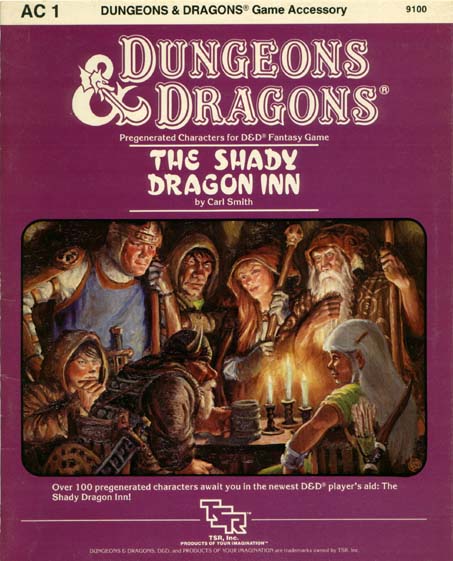
The cover shown is the preserved AC1 image. It supports product identification, while the source records establish the class-and-party arrangement. Neither is a complete census of every character entry or proof of a particular copy's physical condition.
Sources and scope
Product identity, inventory and reproduced publisher descriptions: dd/dd-ac1.htm. These are preserved archive records, not claims of a newly inspected complete copy. No exact character census, unverified map dimensions or AD&D conversion claim. Preparation suggestions are editorial.