
White Plume Mountain: The Job Application That Became S2
Editorial date: · TSR Archive
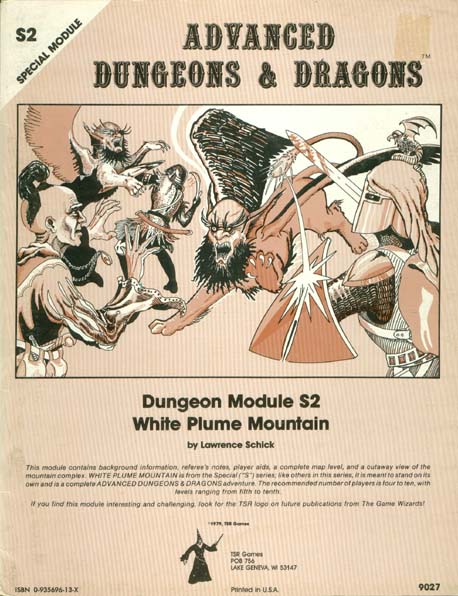
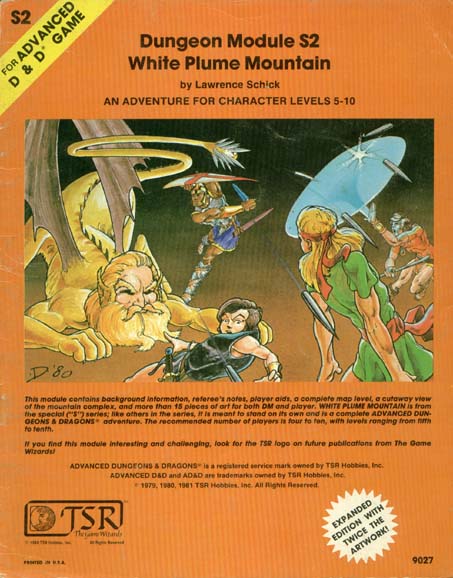
Schick describes the design sample that got him hired. Compare the archived 1979 and 1981 printings before using their maps and player art.
White Plume Mountain began as a demonstration of what its author could design. In a 2009 interview with James Maliszewski, Lawrence Schick said he assembled the adventure from favorite material in his earlier dungeons to persuade TSR to hire him. The submission succeeded: the company hired him and bought the scenario for publication. That origin gives S2 a different starting point from an adventure commissioned for a tournament.
What the designer's account establishes
Schick remembered TSR publishing the submitted scenario without changing its wording. Treat that as his account of the submission's passage into print. It does not establish that every later printing has identical pagination, artwork or editorial treatment. The interview and a comparison of physical copies answer different questions. His description also explains the concentrated design premise: a selection of ideas chosen to demonstrate range. A referee can approach the adventure as a sequence of situations to understand individually, rather than assuming that its short length makes it an introductory teaching text. The publisher's own recommended party is four to ten, with levels ranging from fifth to tenth. That is a substantial step beyond a first-level expedition.
Two recorded formats, the same product number
| Record | Cataloged extent | Identification use |
|---|---|---|
| Third printing, 1979 | 12-page book. TSR 9027, S2. | Use its own cover and internal references when identifying this copy. |
| Fifth printing, 1981 | 16-page book. TSR 9027, S2. | Its description additionally advertises more than 15 pieces of art for DM and player. |
The recorded page difference is a reason to inspect the copy, not a count of added encounters. A book's extent can reflect several production choices. Without a full collation, the archive descriptions do not tell us exactly where all differences occur. Keep the printing label with any page reference you make in your notes. A naked page number can become misleading when a second referee uses another copy.
Prepare the cutaway and player art separately
Both descriptions advertise a complete map level and a cutaway view of the mountain complex. The later description explicitly calls out art for both DM and player. These aids perform different jobs. A referee's spatial explanation can reveal connections that the party has not discovered, while a player-facing picture can communicate a particular scene.
Before play, match each aid you intend to show to the encounter that calls for it. Keep the referee map available for adjudication, and make a separate list of player images in encounter order. In a digital copy, test the actual image you will display: a screenshot that includes the neighboring room key defeats the separation. This is an editorial preparation method, not a claim that S2 prescribes a particular digital workflow.
The same distinction matters in the Barrier Peaks illustration book, although that module has its own origin and physical arrangement. Player art is part of how an adventure delivers information. It is not automatically safe to display every illustrated page in full.
Sources and scope
The hiring story is Schick's attributed recollection. Product numbers, printing labels and advertised aids come from the linked archive records and their reproduced publisher descriptions. This article does not authenticate every S2 printing or report a new playtest.