
Rage of the Rakasta: Solo Play Still Needs the Game Box
Editorial date: · TSR Archive
Rage of the Rakasta supports a DM and one player, a group or play without a DM. Identify its 1993 components and the D&D Game Box requirement.
Rage of the Rakasta offers several ways to arrange the players around a short D&D adventure. It was designed for one DM and one player, yet its publisher also allows a group or a single player without a DM. The no-DM option does not remove the stated need for the D&D Game Box.
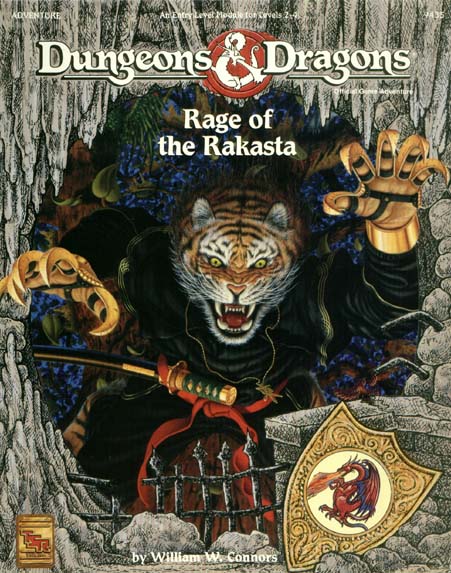
One character is the starting design, with other arrangements allowed
| Arrangement | What is explicitly supported |
|---|---|
| One Dungeon Master and one player | The stated design, for a single character of levels 2-4. |
| A Dungeon Master and a group | An allowed way to play the adventure. |
| One player without a Dungeon Master | An allowed solo option. |
These arrangements identify who is present, not a promise that every group size produces the same encounter difficulty. Read the actual instructions for the chosen mode before preparing the game. A one-character adventure and a one-person game are related ideas, but they are not interchangeable: the first can still have a separate referee.
For a referee and one player, agree which character is entering the adventure and check that character against the printed level guidance. For play without a DM, use the adventure's own instructions rather than assuming that an ordinary referee-facing passage can be read without revealing information.
The Game Box remains a separate requirement
The archive identifies TSR 9435, by William W. Connors, as a 1993 sixteen-page booklet with a fold-up figure sheet and a full-color fold-out map. The reproduced brief advertises twenty stand-up figures, plus new monsters, magic items and a character class. It expressly says that the D&D Game Box is needed.
The figures and map support play; they do not make the booklet a complete replacement for the required game rules. A description such as "solo adventure" answers the player-arrangement question, while "Game Box required" answers the rules-dependency question. Keep both statements in an inventory or recommendation.
The black-box learning cards comparison examines the introductory rule package and the Rules Cyclopedia. That broader reference discussion does not override the specific requirement printed for this adventure.
Thunder Rift and an earlier adventure are optional connections
The publisher places Rage of the Rakasta in Thunder Rift. It says the adventure can stand alone or join a campaign using the related modules, and offers it as a possible sequel to Quest for the Silver Sword. Those are campaign choices rather than a requirement to acquire every connected adventure.
The premise involves Rakasta, presented as samurai cat-people. That description supplies the adventure's flavor; it is not evidence that an AD&D Oriental Adventures rulebook is required. Use the rules dependency actually stated for this D&D product.
Check the map and figure sheet as separate components when identifying a copy. For a digital version, verify which files reproduce those aids and preserve their proportions when displaying them. The local illustration is the archived cover, not a photograph of the twenty assembled figures or a screenshot of the no-DM procedure.
Sources and scope
Product identity, inventory and reproduced publisher descriptions: dd/dd-rr.htm. These are preserved archive records, not claims of a newly inspected complete copy. No solo procedure reproduction, exact class mechanics or AD&D Oriental Adventures requirement. Preparation suggestions are editorial.