
Nightmare Lands: Four Books for Running Ravenloft Dreams
Editorial date: · TSR Archive
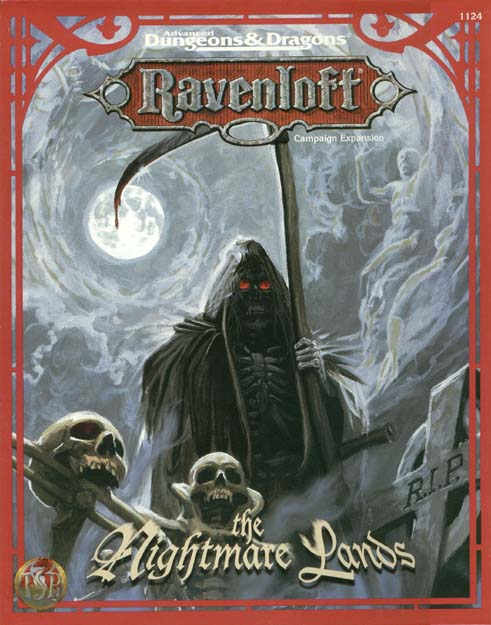
Nightmare Lands separates a fictional doctor’s journal, dream rules, an adventure and new monsters. Identify the 1995 Ravenloft box and its two maps.
The Nightmare Lands divides Ravenloft dream adventuring among four books. A fictional physician's journal introduces an in-world perspective, while separate volumes provide rules, an adventure and monsters. Treating all four as one uninterrupted player handout would lose those different functions.
The four volumes answer different questions
| Book | Extent | Advertised role |
|---|---|---|
| Journal of Dr. Illhousen | 32 pages | The observations of a fictional physician associated with a Nova Vaasa clinic. |
| Rules of Dreams and Nightmares | 64 pages | Dream adventuring, scenario design and dream versions of player characters. |
| Book of Nightmares | 64 pages | A ready-to-play adventure using the setting. |
| New Monsters | 16 pages | Creature material supporting the nightmare realm. |
The archive credits Shane Lacy Hensley and Bill Slavicsek and lists two poster maps. Both the named books and their extents fit the record's format field: two 64-page books, one 32-page book and one 16-page book. Unlike a vague description of "four books," the named inventory gives each component a role.
Keep the journal's narrator distinct from the credited designers. Illhousen belongs to Ravenloft's fiction. His observations can convey a perspective on strange events without becoming the rulebook's own voice or a real physician's testimony.
Dream adventuring needs its own rules reference
The reproduced publisher description presents the Nightmare Man as a threat to heroes who enter through dreaming. The rules volume supplies guidance for dream adventures and for creating dream versions of the characters. That is a different preparation problem from placing an ordinary encounter along an overland route.
Start with the dream rules that the campaign actually uses. Record which character information is carried into the dream version and where the relevant procedure is found. When a player asks what an action can accomplish, the mechanical answer belongs in that rules reference. The journal may offer atmosphere or an in-world explanation, but it should not silently replace a procedure.
For designing an original nightmare, first choose the situation the characters must understand, then consult the book's scenario guidance. Keep any house rulings labeled in the preparation notes. The distinction will help if the same dream situation returns later.
Control information by book and by scene
Before handing material to players, decide what they can learn at that point in the adventure. A fictional document can be evidence within the story, while an adventure passage can reveal information intended for the referee. Check the actual passage rather than assuming an entire component is safe to read ahead.
Inventory the two poster maps independently of the four books. The local cover confirms the product being discussed; it does not display the map interiors or authenticate a particular complete box. A digital or bound reproduction should be checked for its own included files and pages.
The Ravenloft core-book comparison addresses setting references and overlap. The Nightmare Lands adds a specialized mode of play. Its fictional clinic and dream imagery are discussed as adventure material, not as clinical advice or evidence about actual treatment.
Sources and scope
Product identity, inventory and reproduced publisher descriptions: rv/rv-nmlands.htm. These are preserved archive records, not claims of a newly inspected complete copy. No complete dream mechanics, clinical advice or substitute for a Ravenloft core-set comparison. Preparation suggestions are editorial.