
Masque of the Red Death: AD&D Leaves the Medieval World
Editorial date: · TSR Archive
A guide, three adventures and loose aids support an alternate Earth of the 1890s. Separate revised character rules and firearms from familiar Ravenloft habits.
A revolver and a Victorian profession change more than the equipment list. Masque of the Red Death and Other Tales moves AD&D horror into an alternate Earth of the 1890s, with revised character and magic systems suited to that premise. Treating it as an ordinary Ravenloft adventure can miss what the box is offering.
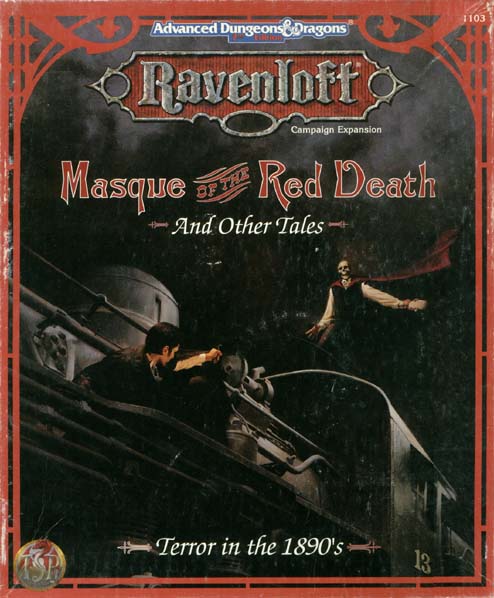
The archive identifies the 1994 package as TSR 1103 and credits William W. Connors, D.J. Heinrich, Shane Hensley and Colin McComb. Its setting is Gothic Earth, a fictional world modeled on our own. The publisher invokes the literary worlds of Poe, Stoker and Conan Doyle; that is a genre invitation, not a claim of documentary history.
The guide and the tales are separate books
| Component | Recorded format | Why it matters |
|---|---|---|
| A Guide to Gothic Earth | 128-page book. | The setting and rules reference for preparing characters and adventures. |
| Red Tide, Red Jack and Red Death | Three separate 32-page adventure books. | Playable situations distinct from the general guide. |
| Loose aids | A map, a poster and a tri-fold referee screen. | Geographic and reference material that may be absent from a book-only offer. |
The publisher describes different locations for the adventures: San Francisco, Boston and an isolated eastern European mansion. A shared box does not make those locations a single continuous journey. Read the selected adventure's own setup before promising the group a particular sequence.
When checking a physical copy, distinguish the setting guide from the adventure book whose title resembles the box title. Ask for the identifying pages and the loose aids. A description that says simply Red Death book may not tell you which component is actually being offered.
Create characters for Gothic Earth
The original description advertises sixteen character kits, a proficiency system adapted to Victorian life, revised spellcasting and rules for firearms and explosives. Those are core preparation subjects. They should not be treated as incidental additions after the players have made characters under different assumptions. Before character creation, decide which reference governs the campaign and read the relevant creation instructions in full. Record the kind of work each character can do, the knowledge the group can plausibly bring to an investigation and how it will obtain information it lacks. The guide supplies the rules; your campaign agreement establishes what the group is trying to play.
Do the same review for magic. A familiar spell name does not guarantee that a character can use it in the familiar way. Consult the revised treatment and communicate the information the characters are meant to know. This article does not provide replacement mechanics or a complete dependency list for other Ravenloft books.
Turn a location into an investigation record
For a chosen adventure, prepare a record with places, people, observations and unresolved questions. Keep the referee's explanation separate from the evidence the characters can obtain. That allows a failed theory to remain a theory rather than forcing it to become the next scene.
Record how an observation becomes available. A conversation, a visit to a location and an examination of an object are different actions. Use the printed adventure where it establishes those links. If you add another route to information, mark it as an addition so it remains consistent when the party returns.
Discuss the intended horror themes with the players before choosing the opening situation. Literary familiarity varies, and a reference that immediately signals danger to one player may mean nothing to another. Provide the information the characters can perceive without requiring the players to have read a particular novel.
Give equipment a rules reference
Prepare the procedures for the equipment likely to appear in the selected adventure. The fact that firearms exist in the setting does not answer how every confrontation works. Consult the relevant rules, then keep those references accessible during play.
Likewise, historical background and setting fact should remain distinguishable. When you add research about a real city, decide whether it is background for presentation or an established fact in your Gothic Earth campaign. Record deliberate changes instead of letting a remembered historical detail silently overrule the adventure.
The Ravenloft setting comparison addresses a different shelf problem. For Masque, begin with the 1103 inventory and the selected tale. Keep the guide open at the character, magic or equipment reference that tale needs first.
Sources and scope
The archive reproduces the original publisher's setting, rules-feature and component description. This article concerns the 1994 box, not a later edition sharing the name. Investigation records and session preparation are editorial proposals; no claim of historical reconstruction or playtesting is made.