
Three Lankhmar Packages: City Reference, Revised Sourcebook and Standalone Game
Editorial date: · TSR Archive
Two City of Adventure books and a later boxed game serve different purposes. Compare maps, rules coverage and the dice requirement before choosing.
TSR published more than one route into Fritz Leiber's Lankhmar. Two products called City of Adventure are city references for AD&D, while a later boxed set presents itself as a standalone role-playing game. A title search can bring all three into the same results. Product numbers and component roles make the choice clearer.

Read the package before the familiar city name
| Product | Recorded contents | Stated role |
|---|---|---|
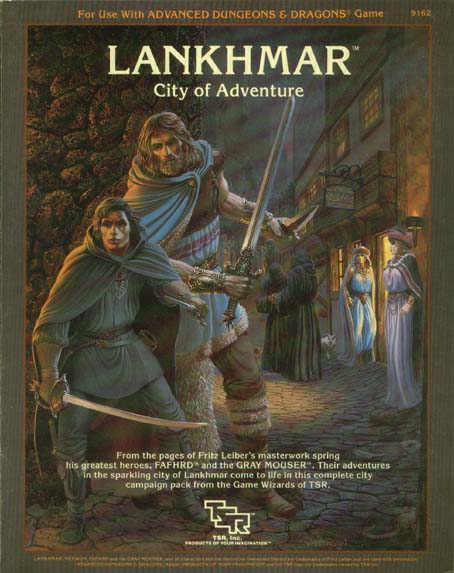
| City of Adventure, 9162 | 1985. 96-page book, 32-page map book and fold-out map. | A Lankhmar setting for the AD&D game. |
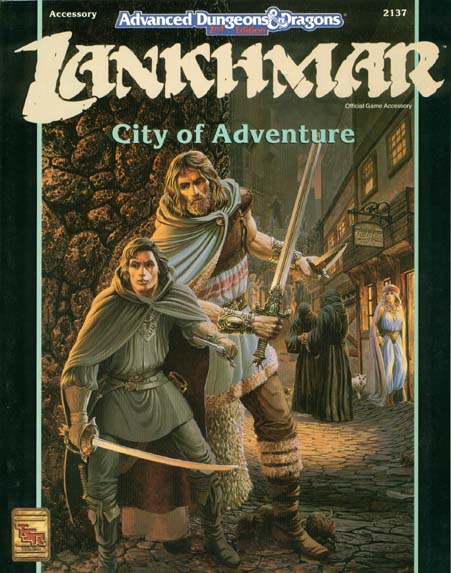
| City of Adventure, 2137 | 1993. 160-page book and fold-out map. | A city sourcebook in AD&D 2nd Edition formats. |
| The New Adventures of Fafhrd and Gray Mouser, 1144 | 1996. Books of 96, 64 and 32 pages, a bi-fold screen and fold-out map. | A standalone game with streamlined rules, described as AD&D compatible. |
The book extents alone do not measure how much city material was retained or rewritten. The important first distinction is between an accessory that supports your existing AD&D references and a package offering its own route into play. A longer book is not automatically a more complete version of everything found in a shorter package.
A map book is not another name for a poster
The 1985 record lists both a 32-page map book and a fold-out map. A used copy described simply as "book with map" therefore leaves a real ambiguity. Establish which book the seller means and whether the loose map survives. The 1993 inventory has a different physical arrangement, so its shorter component list cannot be used to certify an older copy complete. When preparing urban play, put the map you will navigate beside the location references you will actually consult. Mark where a street-level decision leads to another page or another map. If players receive a city view, keep referee-only annotations on a separate working copy. This is a preparation suggestion, not a claim that the three editions share one map key.
Check the individual map before assuming it is a player handout. A poster's size and color do not establish what information its labels reveal. The same caution applies to a digital scan whose filename merely says "city map."
The standalone box has a narrow, useful promise
The 1996 description assigns different jobs to its three books: rules, adventure creation and a prepared adventure. It describes a two-sided poster showing Lankhmar and Nehwon, and explicitly requires a set of polyhedral dice to play. The absence of dice from a copy is not proof that listed boxed dice went missing. The description directs the buyer to obtain them separately.
Its compatibility statement is a publisher claim. It does not mean every character option, spell or encounter can move between the earlier sourcebooks and the streamlined game without inspection. Choose the procedures your table will use, then read a borrowed element against those procedures. Document any change so that another session does not quietly revert to a different book.
For a continuing city campaign, record the people and places altered by play. That living campaign record belongs alongside whichever product you choose. Replacing a reference book does not reset the party's dealings with a neighborhood or faction.
Sources and scope
Dates, components and rules promises come from the three linked archive records and their reproduced publisher descriptions. No full textual comparison or compatibility playtest was performed. For another choice among sourcebooks and boxes, see the Forgotten Realms package guide.