
Hollow World: Preparing a Journey Where the Sun Never Sets
Editorial date: · TSR Archive
Three books and four maps divide player knowledge from referee material. Check changed magic and routes home before taking surface characters underground.
In the Hollow World Campaign Set, the sun never sets and some familiar spells do not work. Those are conditions to prepare before bringing an established party into the setting. If the players discover that ordinary expectations have changed only when a necessary spell fails, the referee needs a clear account of what the characters could have known.
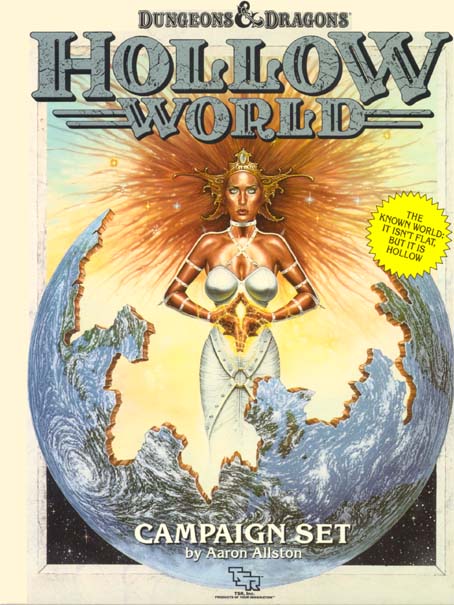
The archive records Aaron Allston's 1990 set as TSR 1054. Its publisher description places an inhabited world inside the Known World and warns that getting out may be harder than getting in. The physical division of the set helps separate the players' introduction from the referee's knowledge.
Different books for different questions
| Component | Recorded format | Preparation use |
|---|---|---|
| Dungeon Master's Sourcebook | 128-page book. | Establish the setting information and referee knowledge needed for the journey. |
| Player's Guide | 64-page book. | Prepare native characters or the arrival of characters from the surface. |
| Adventure Book | 32-page book. | Choose an opening situation and consult the relevant adventure material. |
| Map sheets | Four maps. | Distinguish the inner-world geography, regional detail and outer-world connections. |
A copy containing only the sourcebook does not provide the entire original box. Ask which books and sheets are included. If you use a digital edition, determine how those components are arranged rather than expecting them to behave like separate physical booklets.
The set also advertises adaptation material for AD&D Second Edition. Identify the rules framework your campaign uses before character creation. The presence of adaptation advice is not a reason to assume that every mechanic can be used unchanged in every edition.
Make time usable without sunset
Constant daylight changes an easy descriptive cue: nightfall cannot automatically announce the end of a travel day. Choose how your campaign records elapsed time and communicates opportunities to rest. Consult the actual rules for recovery and spell preparation rather than deriving new mechanical effects from the premise alone. For a first journey, maintain a travel record with departure, elapsed time, encounters and the party's decision to rest. Tell the players what their characters can reasonably use to track time. The record is an editorial aid; it does not add a new clock or a universal rest rule to Allston's setting.
Use the same care with description. An unfamiliar sky can establish the setting quickly, but repeatable information is what lets the players make plans. Keep track of the cues you establish so a later scene does not casually contradict them.
Review the spells the party relies on
The original description says that magic works differently and that some spells fail. It does not provide the full exception list in the catalog text. Use the campaign books for that list and prepare the effects the party is likely to rely on.
Make a note beside each relevant ability: the source of its rule, the setting-specific change and how the character might learn about it. If a ruling is your own adaptation, identify it as such. This is especially useful when adapting the setting to another rules system, where a spell name can survive while its mechanics change.
Keep arrival and return together in the preparation notes. A magical method that brings the party inside should not be assumed to guarantee the same route home. Establish what the characters know about that uncertainty before committing them to a long campaign.
The surface still matters
The June 1991 D&D Reference Guide preserved at Pandius describes Hollow World as a separate product line connected to the Known World. It points to links in The Shadow Elves and The Atruaghin Clans. That contemporary guide is evidence of a connected setting, not a requirement to buy every Gazetteer before beginning.
Choose one connection relevant to the party you have. Record its origin, its destination and what information is available on each side. Then open the adventure material at the place where the journey can actually begin. A usable entrance and a considered way home give the inner world a relationship to the campaign already being played.
Sources and scope
Components, perpetual daylight, altered magic and adaptation advice are stated in the original description reproduced by the archive. The contemporary reference guide supports the product-line and surface connections. No complete spell audit or physical model of Mystara is claimed; travel and preparation records are editorial suggestions.