Dragon Mountain: Three Books, Two Adventures and a Conflicted Inventory
Editorial date: · TSR Archive
Dragon Mountain contains three books comprising two linked adventures. Check its maps, stand-ups and conflicting card and handout counts before judging a box.
Dragon Mountain is a useful warning against counting a campaign by its booklets. The 1993 box has three main books, but the publisher says they comprise two adventures linked into a campaign. Its archive record also preserves incompatible totals for some loose components. A reliable checklist needs to show that conflict.
Three books do not mean three adventures
The archive identifies TSR 1089, by Colin McComb and Paul Lidberg, as three 64-page books. Its reproduced publisher description explicitly calls their contents two adventures. Keep the physical division and the story division separate when deciding what to prepare next.
The advertised campaign centers on a red wyrm and a fortress defended with traps, puzzles and resourceful minions. That suggests preparation beyond the dragon's own statistics. Read the location's defenses and the information the party can obtain before treating the climax as a single isolated fight. This is an editorial preparation recommendation, not a claim about a fixed number of required sessions.
Use the book and encounter references supplied by the actual box. A reference to the "second adventure" need not mean the second physical book. Write both references together in campaign notes so another referee can find the intended passage.
The archived card and handout counts disagree
| Component | Format field | Reproduced publisher description |
|---|---|---|
| Main books | Three books, 64 pages each | Three books comprising two adventures. |
| Maps | Six fold-out maps | Six maps; two join into a large tactical playing surface. |
| Reference cards | Fourteen cards | Twelve reference cards. |
| Handouts | Fourteen pages | Sixteen handouts. |
| Monster material | Eight loose five-hole pages | Eight Monstrous Compendium sheets. |
| Playing pieces | Stand-up sheet and twenty-four plastic stands | Stand-up pieces and twenty-four bases. |
The format field also records a fold-out poster of the cover art. The different card totals are a direct disagreement. The handout statements additionally use different counting units: pages and handouts. Neither difference proves a printing variant, a missing item or an equivalence between pages and sheets.
Describe a copy before certifying completeness
For an actual box, photograph the loose pieces and record printed titles or component codes where present. Note whether a counted item is a sheet, a page, a separate card or an image on a shared sheet. Compare that inventory with both archived statements. A claim of complete contents needs evidence beyond choosing whichever total matches the copy.
The two maps intended to form a tactical surface deserve a separate preparation check. Lay out the correct pair in advance and confirm the joining edges against the printed material. The remaining maps have their own uses; six maps should not be described as six equal sections of the same board.
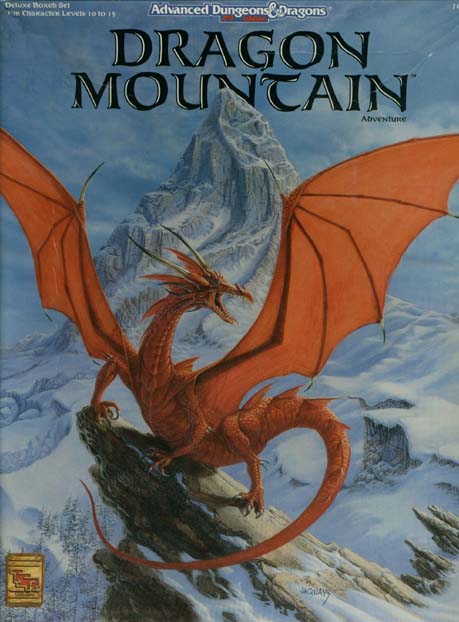
The Night Below inventory examines another large campaign package. Its component counts do not resolve this box's discrepancy. The illustration here is the archived Dragon Mountain cover, not a photograph proving that every loose item is present.
Sources and scope
Product identity, inventory and reproduced publisher descriptions: dd1/dragonmt.htm. These are preserved archive records, not claims of a newly inspected complete copy. No invented printing variant, certified completeness or exact encounter and level survey. Preparation suggestions are editorial.