
Council of Wyrms: Dragon Campaigns in a Box and a Hardcover
Editorial date: · TSR Archive
The original set separates rules, setting and adventures. Compare its loose reference material with the revised hardcover before choosing a dragon campaign.
Council of Wyrms makes the dragon a player character and builds a campaign around that change. Its original books have distinct roles. The later hardcover repackages and expands the material. Choosing between them begins with physical identity, then moves to the kind of group you intend to play.
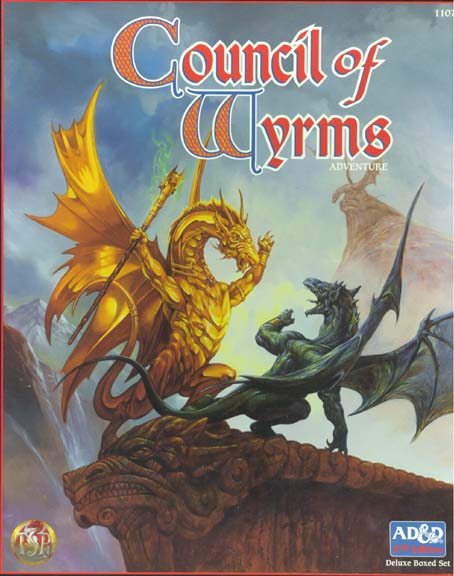

The archive records both as Bill Slavicsek publications for AD&D: the 1994 box, TSR 1107, and the 1999 Campaign Option hardcover, TSR 11383. A listing that says only Council of Wyrms leaves that distinction unresolved.
Loose aids and a bound reference
| Version | Recorded contents | What to check |
|---|---|---|
| 1994 box | Three 64-page books, twelve accessory sheets or reference cards, and three fold-out map or poster aids. | Which books and loose pieces are actually present. |
| 1999 hardcover | A 208-page book, described as updated and expanded, with a sixteen-page color section. | The book's own reference arrangement and how you will use its illustrations at the table. |
In the box's description, the books cover rules, campaign and adventures. It also describes a size-comparison chart, an island-home map and a clan guide among the large aids. Those pieces are useful for different questions. A geographic sheet does not substitute for a chart that communicates the scale of a dragon.
The hardcover's description advertises revised material and coverage of fifteen metallic, chromatic and gem dragon varieties. That is a stated scope for this book. It is not evidence that every dragon in every AD&D monster reference can be used as a player character without further work.
Agree on whose campaign this is
The original offer includes dragon characters, elf, dwarf and gnome kindred, half-dragons and dragon slayers. These roles are not interchangeable labels for a standard adventuring party. Before making characters, agree which options the group will use and how their interests can support a shared campaign. Write down what each player expects to do during a session. A group interested in dragons' political relationships may want different situations from one interested mainly in exploration. If the campaign moves between dragon and humanoid perspectives, discuss when that happens and how everyone remains involved.
Use the actual character-creation rules to settle eligibility and development. A monster entry is a reference for a creature, not necessarily a complete player-character procedure. The setting's attraction is easier to realize when players know which rules will define their dragons before a dramatic scene exposes an assumption.
The map must fit the characters
Dragon characters change the questions a location needs to answer. Examine approach routes, available space and the relationship between travel and local encounters. Record what the published adventure establishes, then mark any alteration you make for your party.
The size-comparison material is useful preparation evidence: it gives the group a shared way to understand the creatures it is describing. It does not automatically settle every movement question. Keep the relevant rules nearby and choose situations whose important spatial relationships can be explained clearly.
A referee can begin with a limited campaign area rather than fully detailing every clan. Select an opening problem that gives the chosen characters reasons to cooperate. Keep their commitments and relationships with the location notes so the next adventure follows from the one they played.
Choose the working reference
If you have both presentations, select one as the table's rules reference. Consult the other for comparison, but do not alternate between passages without noting which treatment the campaign uses. This article has not performed a rule-by-rule collation of the revisions.
For a used box, ask for photographs that spread out the loose material. For a hardcover, check the identifying pages and the condition of the bound reference. Do not assume that a statement about the original box's accessories describes what accompanies the later book.
Keep the product number with your campaign notes and place the chosen adventure beside its rules reference. That makes a later question answerable without guessing whether someone remembered a box, a hardcover or a monster description from another source.
Sources and scope
The two archive entries reproduce the publisher's format, character-role and revision descriptions. This article does not verify that every loose aid was reproduced unchanged in the hardcover. Session agreements and spatial preparation are editorial suggestions rather than additional Council of Wyrms rules.