
Battlesystem: From the 1985 Box to the 1989 Miniatures Book
Editorial date: · TSR Archive
Douglas Niles explains the jump from individual characters to military units. Match the rulebook, play aids and conversion assumptions before staging a battle.
When a player character begins commanding troops, resolving every combatant as an individual can overwhelm a roleplaying session. In his 2020 interview with James Maliszewski, Douglas Niles described that problem as part of the impetus for Battlesystem, alongside a return to D&D's miniatures roots.
He identified a concrete design challenge: converting familiar individual attributes into ratings that work for military units. That helps explain why using Battlesystem requires more preparation than placing more figures on an ordinary adventure map. It also makes the difference between the original box and the revised book worth checking.
The box and the book
| Publication | Physical offer | Decision it affects |
|---|---|---|
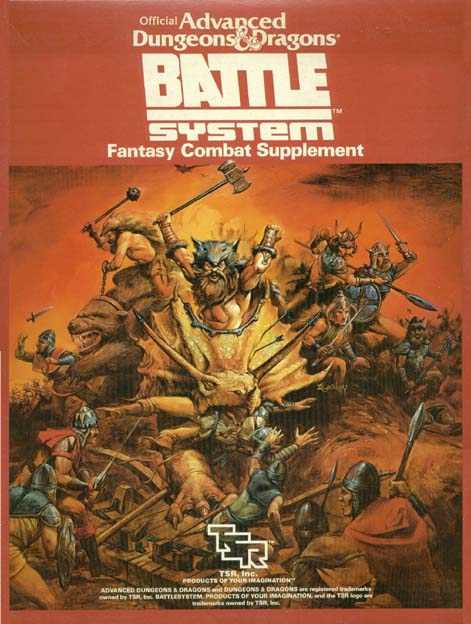
| Fantasy Combat Supplement, 1985, TSR 1019 | A boxed package with printed material, reference cards, miniatures, counters and fold-up accessories. | Which rules and physical play aids actually remain in the offered box? |
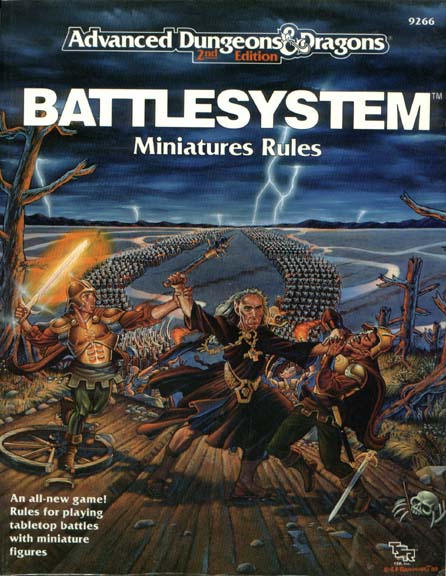
| Miniatures Rules, 1989, TSR 9266 | A 128-page book described as a revision and expansion of the original system. | Which miniatures, terrain and scenario materials will you provide separately? |
A book can supply a complete rules presentation without supplying figures or a battlefield. Conversely, a box containing counters does not establish that every booklet and reference card remains inside it. Check the physical copy against a component inventory appropriate to that version.
The archive's summary and reproduced back-cover inventory for the original box do not agree in every detail about its printed books. This article does not resolve that discrepancy. If completeness matters, inspect the individual pieces rather than using one summary line as a definitive checklist.
An army is another level of abstraction
Niles's account gives a useful preparation test: what does a figure represent in the rules you are using? Record that scale before converting a campaign's forces. A count of painted miniatures is not yet a usable army roster.
Use the chosen rules to establish unit characteristics, leadership and the treatment of exceptional combatants. Keep the original character or creature record beside the converted entry so that you can distinguish a source statistic from a battlefield rating. Do not assume a value with a familiar name has the same job at both scales.
Magic deserves its own review. The original boxed description advertises magical and unusual battlefield effects, but a broad compatibility promise is not a procedure for every situation. Identify the effects likely to appear in the planned battle and read how your selected edition handles them.
Prepare a bounded battle
For an initial game, agree on an objective that can be recognized when it happens. Holding a crossing, moving a force off an edge or retaining access to a route each creates a different problem. These are possible editorial scenario goals, not claims about the objectives printed in a particular Battlesystem scenario. Prepare the forces, deployment information and terrain needed for that objective. Then check the procedures that connect them: movement, contact, morale and the end of the battle. If a rule will decide an important result, both sides should know where it is before play reaches that point.
Keep a short conversion note with the roster. State which Battlesystem publication you used and which campaign rules supplied the characters. The 1989 description explicitly allows play without the AD&D books while also supporting conversion from an AD&D campaign. Those are two uses of the book, not a requirement to have an ongoing roleplaying campaign before staging a battle.
Return the result to the campaign
Decide beforehand which battlefield results the roleplaying campaign will retain. Record the objective's outcome, the fate of important participants and the state of the place being contested. If a result needs interpretation, distinguish the battle rules from the ruling you make to connect them to the next session.
This differs from the War Machine and high-level Basic material discussed elsewhere in the Blog. A campaign may contain armies in either case, but that shared subject does not make the procedures interchangeable.
Finish the roster with its rules source and conversion notes attached. That gives a rematch, a later scenario or another referee a definite basis for understanding what those figures represented.
Sources and scope
Product formats and the revised book's stated independence come from the linked archive descriptions. Niles's explanation is attributed to question 6 of his October 9, 2020 interview. This is not an exhaustive rules comparison or a reconciliation of the original box's conflicting inventory summaries.