
B4 The Lost City: Where the Ready-Made Adventure Ends
Editorial date: · TSR Archive
The original introduction separates keyed upper levels from a sketched continuation. Prepare supplies, faction contacts and the move into Expert play.
The Lost City contains both an adventure ready to begin and material a Dungeon Master is expected to develop. Confusing the two can turn a promising campaign into a surprise writing assignment. The original introduction states where its detailed opening gives way to an outline.
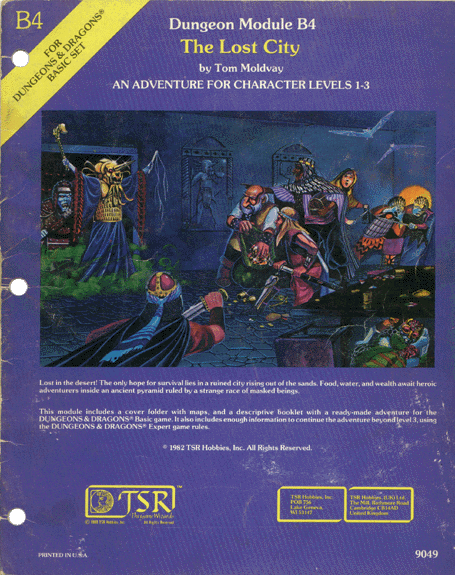
Tom Moldvay's B4 was published in 1982 as TSR 9049. The archive entry preserves its promise of Basic play with room to continue under Expert rules. The useful question is how much of that continuation you want to prepare before the players reach it.
What the introduction actually promises
In the original preview, printed page 2, the opening is designed for six to ten characters of levels 1 to 3 and requires the Basic rules. It describes exploration of the upper step-pyramid. Part 5 outlines lower areas, and the underground city can become the basis of a larger campaign.
An outline is useful material, but it is a different product from a keyed encounter. Treat the boundary as a planning decision. You may run the developed opening before committing to a long campaign, or you may decide that rebuilding the lost civilization is the goal from the start. Either approach needs a clear account of what the referee must add.
| Material | How to use it | Preparation question |
|---|---|---|
| Developed upper adventure | Read the encounter keys alongside their maps. | What can the starting party reach, learn and survive? |
| Lower-area outline | Use the supplied direction as a basis for your own development. | Which locations need details before the party enters them? |
| Underground city | Choose a limited campaign focus from the larger situation. | What goal gives the party a reason to stay? |
Survival makes the first contact matter
The introduction emphasizes that the party cannot simply replace its equipment and supplies from an ordinary nearby shop. Begin with a record of what the characters carry and what they know about obtaining necessities. A conversation can matter because it changes their prospects for surviving another expedition.
That gives the setting's factions a practical place in preparation. The sample describes groups associated with Gorm, Usamigaras and Madarua. Read their actual offers and restrictions before turning them into interchangeable sources of rumors. Joining, cooperating and merely speaking with a group need not produce the same relationship.
For your notes, separate a faction's printed position from what the player characters have done. Add the location of the relevant encounter and a brief record of any agreement. This suggested record does not replace Moldvay's descriptions or assign new motives to the inhabitants. It helps an agreement survive the interval between sessions.
Prepare the next reachable place
A referee can spend a great deal of time detailing the entire hidden city before discovering which part interests the group. Instead, identify the next place the characters could reasonably reach and the information they would need to choose it. Develop that connection first.
Write an explicit stop point for preparation. It might be the boundary of a keyed area or a route into an outlined location. When the party approaches it, you can decide whether there is enough developed material to continue. A clear boundary is preferable to silently inventing a long sequence while pretending it was all printed in B4. The transition to Expert play also deserves a rules note. Record the procedures you will need beyond the opening's scope and where you will consult them. Moving into a larger campaign is not just a matter of increasing a monster's numbers. Travel, access to resources and the time between expeditions can change what the players are deciding.
Cover color is a weak rules reference
Older introductions sometimes describe rulebooks by their cover colors and by edition numbers that belong to the Basic line. Read those references in the publication's own context. A familiar color on a later box does not prove that the writer meant that later edition, and a Basic edition number does not mean AD&D Second Edition.
Identify the rules by title and publication context, then locate the needed procedure in your actual book. Keep that note beside the point where your expanded adventure leaves the developed pyramid. It gives the next session a concrete starting place without requiring a complete new city in advance.
Sources and scope
The preview's introduction supports the party range, Basic requirement and outlined continuation. Its background identifies the factions. This is a preparation guide to that stated boundary, not a full review of every encounter or a claim to have completed the lower city.